Wednesday, August 17, 2016

Cupping Explained!


Cupping: What were the marks on Michael Phelps' back?

Updated 9 Aug 2016, 1:36am
Micahel Phelps with cupping bruises at Rio OlympicsPHOTO: Michael Phelps cheering on his team-mates with a visible "cupping" spot on his back and shoulder(AP: Lee Jin-man)

When US Olympian Michael Phelps jumped into the pool this week in Rio, it wasn't just his 19th gold medal that made headlines.


Phelps had large, circular bruises that covered his back and shoulders, causing some to question whether they were the result of a paintball session or perhaps falling asleep on all his medals.
But as it turns out Phelps is a fan of cupping.

What is cupping?

It is an ancient therapy, said to be used in ancient China, Greece and Egypt, where glass or plastic cups, sometimes heated, are applied to the skin.
They are usually placed on the back or arms or legs and either heated or pumped to suck the skin into the cup.
In most cases a flammable liquid is put into the cups to create suction.
Some therapists move them around on the back, other leave them on the skin untouched, before taking them off.

What does it supposedly do?

It is said to promote blood flow and bring toxins to the surface of the skin.
People undergo the treatment for a range of health issues including muscle tension, arthritis, sleep issues, fertility problems and pain relief.
However Australian Acupuncture and Chinese Medicine Association vice president Waveny Holland said the use of cupping was up to the practitioner, and not generally used for specific medical ailments.
"It's not a blanket thing like Western medicine," Mrs Holland said.
"Practitioners will treat their patients according to their specific needs.
"Cupping isn't generally used for headache or infertility ... it would be on the practitioner's diagnosis and assessment that they will choose the right treatment for that person."

What about the bruises?

Well, Mrs Holland said her training taught her not to leave any bruises after a cupping treatment.
"For me again, I use it sliding (the cup) and that's like doing a deep-tissue massage without leaving the marks," she said.
"You don't put them over broken skin at all or anything like that.
"You don't want to cause any more bleeding."

Why do athletes do it?

It is said to help improve recovery and promote blood flow.
"I'd be interested to know whether they are Chinese medicine practitioners, whether their professionally trained or whether they're just practitioners who think that cupping might be good thing to do," Mrs Holland said.
A woman putting cups on the back of Michael Phelps' legsPHOTO: Michael Phelps showed his love of cupping on his Instagram account (Instagram: Michael Phelps)
US gymnast Alexander Naddour is also a fan.
He told USA Today that it was "better than any money I've spent on anything else".

What does science tell us?

Not much, according to Australian Medical Association vice president Dr Tony Bartone.
"What I can say is that cupping has, from our perspective, no medical benefit whatsoever," Dr Bartone said.
"There is no evidence to suggest — not proven evidence — to suggest that it has a role to play."

Is it dangerous?

Well, it can be.
"Well look ... the theory is it is using a suction to draw ... toxins out of the blood to the surface [and] the pressure, that creates bruising beneath the skin," Dr Bartone said.
"You're breaking ... capillaries... that bruising or bleeding may be extensive and may create deep bruising within muscle which may, in really bad cases, could create some deep scaring or nodules.
"Because some practitioners use heat ... burns are not an uncommon consequence of cupping, not to mention the impressive bruises that are visible for all to see."

So, should you avoid Chinese medicine?

Not necessarily. Dr Bartone said cupping was "one of the more extreme ends" of Chinese medicine.
"Acupuncture has got a role to play," he said.
"It's used by many leading pain management clinics.
"[Cupping] just unfortunately doesn't stand up to the same rigour of scrutiny."
Mrs Holland said it was important to seek out professionals with proper qualifications.
"There's a lot of controversy going around Chinese medicine," she said.
"Chinese medical practitioners have to have a minimum of a four-year bachelor degree [in] Chinese medicine to be registered and practice and we've got to maintain our professional development every year to maintain that registration to practice.
"The national law is supposed to protect [the public] from people who are not properly trained."

Saturday, August 6, 2016

Acupuncture May Slow Memory Loss


Image: Acupuncture May Slow Memory Loss

Acupuncture may benefit people who have memory loss, but don't yet have dementia, suggests a review by Chinese researchers of five earlier studies.

Nothing has yet been proven to halt the progression to dementia in those who are destined to progress. But, acupuncture used alone or along with another treatment, such as the medication nimodipine, might help retain some memory function, the researchers said.

But several doctors not involved with the review said it was too soon to say that acupuncture might be effective against dementia.

For the study, Min Deng and Xu-Feng Wang, from Wuhan University in China, reviewed five previously published studies done in 2012 and 2013.

The trials included nearly 600 people with mild cognitive impairment, a type of memory loss that's considered pre-dementia. About 5 percent to 10 percent of people with mild cognitive impairment develop dementia each year, the study authors noted.

The researchers concentrated on people who had a specific form of mild cognitive impairment called amnestic. People with this type of impairment are even more likely to develop dementia, the review authors said.

The studies compared the benefit of acupuncture alone versus nimodipine. Or, looked at the two treatments together compared to nimodipine alone.

Patients received treatment three to five times a week for eight weeks in four trials. The fifth trial lasted for three months.

The combined data from all five trials showed that those receiving acupuncture did better than those on nimodipine alone.

The acupuncture patients scored better on two tests of memory and dementia: the mini-mental state exam (a 30-point questionnaire that measures mental impairment), and picture recognition.

In addition, the combination of acupuncture and nimodipine improved scores on the mini-mental state exam compared with nimodipine alone, the researchers found.

Three trials reported side effects, which for acupuncture included fainting during treatment and slow bleeding at the needle sites. Side effects reported for nimodipine included nausea, constipation and mild headache, according to the report.

Dr. Remy Coeytaux is an associate professor in community and family medicine and an acupuncture researcher at Duke University in Durham, N.C. He was one of the experts reluctant to embrace the review's findings.

"The studies suggest that acupuncture is effective, but my degree of confidence in this finding is low, [but] it's not zero," Coeytaux said.

The problem is that "the quality of the studies really was poor, so that puts a damper on the findings, because it's hard to trust the data from the original studies," explained Coeytaux.

"There is high risk of bias in all the studies," he added.

Coeytaux suggested that some of the benefit seen from acupuncture might be a placebo effect. But, it's impossible from this review to know how much, if any, was a placebo effect, he explained.

What is known is encouraging, but there is need for a larger, better designed trial to really see if acupuncture can help, he said.

However, because there aren't any really effective treatments for memory loss, trying acupuncture is something patients can do -- it may not help, but it won't hurt, Coeytaux noted.

Another review skeptic is Dr. Sam Gandy, director of the Center for Cognitive Health at Mount Sinai Hospital in New York City. "I tend to believe some holistic interventions when properly executed," he said.

For example, Gandy noted that meditation in Alzheimer's disease patients is potentially credible and promising.

"That said, I don't believe anything until it is independently replicated," he said.

"I can imagine some ways in which acupuncture might increase alertness and attention and thereby memory, but I would want to see independent replication," Gandy added.

The new report was published Aug. 4 in the journal Acupuncture in Medicine.

© HealthDay 

Tuesday, May 17, 2016

Emergency Room Patients are Choosing Acupuncture Instead of Painkillers at Minneapolis Hospital


Beth McDonough
Updated: 05/06/2016 7:04 AM
Created: 05/05/2016 9:29 PM

Overdoses from painkillers and heroin are just about as deadly as car crashes in Minnesota.
Last year, 336 deaths were linked to the use of opioids or heroin.  In contrast, 411 people died in crashes.  Fatal facts like that drove a Minneapolis hospital to find another way to tame the pain.
Abbott Northwestern is the first hospital in not only Minnesota, but the country, to offer acupuncture in the emergency room.
Chris Tanita of Minneapolis took advantage of that one day in April.

"I had the most intense pain on the side of my throat and neck," Tanita said.
Tanita couldn't swallow or sleep and couldn't take the pain anymore.  Anxious and afraid, she came to the emergency room at Abbott Northwestern for relief.

"I want pain medicine for the fever," she said.

She wanted something to numb her suffering.  What she got was an option from Acupuncturist Adam Reinstein.

"I talked to your doctor and he wants me to see if you want acupuncture to make you more comfortable," he said.
Instead of getting a pill, she got poked.  Reinstein inserted the tiny, thin needles in certain spots. Needles can be inserted in places such as the hands, arms and ears to stimulate nerves, muscles and tissues.

"I am triggering their bodies own natural healing ability to produce their own painkiller's endorphins, they may help release them," according to Reinstein.
Within 30 minutes, Tanita felt the flare-ups fade, her fever go down and her throat relax.

"I literally couldn't talk three and a half hours ago," she said.
At this hospital, in the heart of the city, emergency room doctors treat almost 50,000 patients a year according to Dr. Christopher Obetz.

"It's a place where people are first exposed to painkillers and a place where people who already have addictions will come to acquire additional pain medications," Obetz said.
Abbott Northwestern's research points out 49 percent of people who come to the ER either receive painkillers as part of their treatment or get a prescription for them when leaving.  A national study shows 15 percent of the patients who are naive to painkillers and exposed to them for the first time in the ER become addicted within six to nine months.
That led Abbott Northwestern to launch a first-of-its-kind study to determine whether acupuncture is effective when used in addition to, or instead of, painkillers.

Jeffery Dusek is the lead researcher at the hospital's Penny George Institute of Health & Healing.

"I think we're at the point where patients aren't so concerned about what's going to reduce the pain as long as something can reduce the pain and if acupuncture can do it, they're in for it," Dusek said.
Adam Reinstein checks the patient board, talks with doctors and makes the rounds, looking for someone seeking pain relief.  Since the study started in 2013, a majority, 89 percent of 850 patients have been willing to give acupuncture a shot.  In 2013, 99 did.  That number more than tripled in 2014 to 371, then scaled back to 245 in 2015.  Dusek noticed something important, "we're seeing less use of opioid's in the ER when they're receiving acupuncture."
Dusek says 20 percent less, saving the hospital a lot of money.  What's more, some patients leave the ER without a prescription at all. 
Yet, Dr. Stephen Barrett openly questions the value of acupuncture.

"The scientific consensus is acupuncture is not particularly effective for pain, it's not better than a placebom: Barrett said.

Barrett practiced medicine for 35 years and runs a number of consumer health websites, including Acuwatch.org, where he refers to acupuncture as needles with nonsense.

"Listen, I don't believe in ghosts either and that's the equivalent of a ghost in your body," he added.
Yet, folks at Abbott Northwestern believe the benefits are very real.  The idea is to stick it to pain by combining Eastern remedies along with Western medicine.  5 EYEWITNESS NEWS was there as Jack Weston, of Edina, was being released from the hospital.  He wanted us to know he's tried both, and prefers one over the other.

"I would stay with the medicine if push came to shove, because I think it's likely more effective in the long run," he said.
However, staff at Abbott Northwestern believe acupuncture in the ER could reduce not only throbbing aches, but the use of painkillers and the number of prescriptions doctor's write, benefiting folks inside the hospital and even more outside of it.

"I think it's more societal costs if we could avoid people being dependent on opioids and all the consequent increases of hospitalizations and readmissions after that, I think that's where the benefit is," Dusek said.
As for Tanita, she's just as afraid of addictive meds as she is the pain itself.

"At least for me and how I want to live, I prefer to not take pills, you know the less foreign weird stuff in my body the better," Tanita said.
Tanita says part of what she liked about the program was she got to choose whether she wanted to take part. 
Acupuncture in the ER can be a one-time fix, or it can become ongoing treatment.  When a patient leaves, they can get a referral to the Penny George Institute, it's an outpatient clinic, or folks can go to any of the 584 licensed acupuncturists in the state.
The pilot program lasts another year.  The hospital is applying for a federal grant to continue and expand the study. 

Thursday, May 5, 2016

Science suggests acupuncture works, but no one is sure why

Image result for acupuncture
When the writer and artist Margarita Gokun Silver had her first migraine after she turned 40, the pain was so bad she vomited before lying in bed, completely incapacitated for the rest of the day.

Over-the-counter painkillers didn’t work. Her doctor, who assured her there was no underlying cause for her migraines, gave her expensive pain medication to try, but it left her with debilitating nausea. After trying a variety of other therapies—ranging from yoga to Canadian painkillers to Botox—she finally settled on acupuncture. It was the one thing that worked, she recently wrote in the Washington Post.

Acupuncture—the act of sticking tiny needles into different parts of the body to try to relieve pain elsewhere—is based on Chinese medicine from over 2000 years ago. In Chinese tradition, acupuncture helps realign the body’s qi (pronounced ‘chee’), which is the energy that flows through various parts of your bodies. It was assumed that when you were in discomfort, either as a result of pain or nausea, your body’s qi was misaligned; the tiny needles, sometimes augmented with heat or electricity, could help realign that energy, with the minor side effects of possibly a little on-site pain and light bleeding.

Although acupuncture was mostly abandoned between the 18th to 20th centuries, it was still practiced informally by Chinese traditionalists. It caught the attention of Westerners when, in 1971, the treatment was provided for a New York Times journalist in Peking, who later wrote(pdf) about the experience.
When the writer and artist Margarita Gokun Silver had her first migraine after she turned 40, the pain was so bad she vomited before lying in bed, completely incapacitated for the rest of the day.

Over-the-counter painkillers didn’t work. Her doctor, who assured her there was no underlying cause for her migraines, gave her expensive pain medication to try, but it left her with debilitating nausea. After trying a variety of other therapies—ranging from yoga to Canadian painkillers to Botox—she finally settled on acupuncture. It was the one thing that worked, she recently wrote in the Washington Post.

Acupuncture—the act of sticking tiny needles into different parts of the body to try to relieve pain elsewhere—is based on Chinese medicine from over 2000 years ago. In Chinese tradition, acupuncture helps realign the body’s qi (pronounced ‘chee’), which is the energy that flows through various parts of your bodies. It was assumed that when you were in discomfort, either as a result of pain or nausea, your body’s qi was misaligned; the tiny needles, sometimes augmented with heat or electricity, could help realign that energy, with the minor side effects of possibly a little on-site pain and light bleeding.

Although acupuncture was mostly abandoned between the 18th to 20th centuries, it was still practiced informally by Chinese traditionalists. It caught the attention of Westerners when, in 1971, the treatment was provided for a New York Times journalist in Peking, who later wrote(pdf) about the experience.

Monday, April 25, 2016

Pregnancy & Acupuncture

Pregnancy is a period of growth that brings many physical and emotional changes. Some of these changes can cause uncomfortable symptoms. Since pharmaceutical medications are generally not safe during pregnancy, acupuncture is a safe and effective alternative to bring relief to the mom-to-be.

Here are some of the symptoms that research has shown are relieved by acupuncture:
• Gastrointestinal upsets. Most women prefer acupuncture over medication, with vomiting and nausea related to morning sickness showing improvements from the first session. It also alleviates heartburn and constipation.
• Pain and swelling. Acupuncture can help significantly to ease pain in the lower back, pelvic pain, swelling in the legs and carpal tunnel syndrome, all common during the second and third trimesters.
• Breech position. Acupuncture (in conjunction with moxibustion) relaxes the muscles in the uterus and abdomen, as it controls the movements of the uterus. This creates the ideal conditions for the baby to turn.
• Sleep problems and fatigue. Acupuncture can help pregnant women get more restful and rejuvenating sleep. It also increases fuel production and energy levels, helping women cope with the physical demands of pregnancy.
• Stress, mild to moderate depression, and headaches. Acupuncture significantly reduces stress and anxiety during pregnancy, labor and delivery. Depression, which affects nearly a quarter of pregnant women, can also be alleviated with acupuncture, as can the occurrence of pregnancy-induced headaches.
• Labor induction and shortening the length of labor. Acupuncture can be used to prepare the mother’s body for labor and delivery. It is also effective at reducing the length of labor and the need for medical interventions.
• Postnatal. Acupuncture assists physical and mental recovery after delivery, preventing fatigue and mood swings. It can improve blood circulation, leading to improved breast milk supply. Other postpartum issues commonly treated with acupuncture are urination difficulty, abdominal cramps, bleeding, hair loss, fever, night sweats and mastitis.
These are just a few ways that your acupuncturist can help you get through the nine months of pregnancy with ease.


By DR. WENDY CUNNINGHAM/Cunningham Chiropractic

Tuesday, April 12, 2016

New York Times Presents....

A Good Read: Why I Recommend Acupuncture

Ilona Szwarc for The New York Times
When I was younger, I frequently met people who evangelized for universal LSD consumption. A wider perspective, the acid-eaters tried to explain. A benevolent system. They always seemed half-dead to me, some part of them already partaking in the next world, turned away even as they stared into my face and tried to explain. I once watched one of them almost overdose on laughing gas, leering, muttering nastily at my head, his face blue as day. It was indecent, his romance with death. It should have been private. They all just seemed as if they’d willingly trade life for what might be nothing. They seemed infected by the same unexamined certainty as the religious and the insane, mistaking it for some greater ontological understanding.

And then one day I thought I should visit the acupuncturist on Hyperion Avenue. I’d driven past it every day for months. I don’t remember why it suddenly seemed like a good idea. I mean, I remember generally. I was troubled. Things were going wrong. I could produce no reason for it. I thought I might be carrying a backlog of sadness, that it had begun to corrode my life from the inside.

Because I have chronic inflammatory demyelinating polyneuropathy, an autoimmune disorder affecting the peripheral nerves, I’ve had so many venipunctures that the crooks of my elbows are pitted with scars. They look about the same as the scars of my friend who shot heroin for seven years. I’ve had four central lines in my subclavian vein, two on each side. One end tunneled under the skin and then fed into the vein; the other end flopped around on the surface. One of them stayed in for a year. I did six months of the flushing and dressing changes for the line myself. I’ve watched my blood go in and out, lost count of the gallons of other people’s plasma I’ve used, dirtied with autoantibodies, bled back out. I’ve given myself dozens of shots in my legs. All of which is to say that I wasn’t afraid of needles.

Acupuncture points, their location on the body and the body part they treat:
‘‘Bubbling Spring,’’ on the foot: head.
‘‘Calf’s Nose,’’ on the knee: knee.
‘‘Great Hammer,’’ on the spine: back.
‘‘Palace of Toil,’’ on the hand: mouth.
‘‘Cloud Gate,’’ below the clavicle: lungs.
‘‘Spirit Court,’’ on the head: nose.

I was, however, afraid that I might lose my grip on reality and go delicately insane, right there on the table. My nightmares were already bad enough. I preferred to keep my inner terror invisible and unknown. I respected fear, didn’t need to transcend it, but mine was distributed oddly. There were certain things I was an ace at — I’m still a first-rate hospital patient — but it had been six years since I’d driven on a freeway. I was taking pills to get out of bed and more pills to get back in. Small, daily things were becoming impossible.

Probably the decision took place in some barely knowable part of my reasoning mind; once made, I found it easy to find the number of the place online and then drive there, park, go inside, take in the obligatory dribbling fountain and pamphlets about tinctures and powders. The acupuncturist was white, white-haired, beaming, intelligent. I went into a little room. The sheets were softer than any I’d ever felt. Eight hundred thread count? Nine hundred? Is that even a thing? It was like lying on the underside of a giant cat.

Pulses were taken; my tongue was observed. Apparently, my liver chi was trapped, which was getting the organ hot and burning up my heart energy. I didn’t care about the words. I just wanted to keep hoping this person would be able to help me. He had worked in the film industry for years and years, and started studying acupuncture when he was 40. Forty! You could start something at 40; I was 40 then. It was a revelation. I planted my face into the headrest.

Lying there, prone, holding in my flesh a number of those little pins you can’t quite feel, I caught the glimmer of an understanding that the slight concentration of energy in and around my body at that moment could just barely be distinguished from the rest of the universe. I began to understand that what I called my self was physically de­limited not by my body but by a concentration of energy in and around it. I tried to determine how far out into the air it reached. Four inches? I couldn’t sense a boundary. It haloed me and faded into the surrounding space.

You hardly feel the needles. It’s your weakening grip on reality that’s scary.
I began to understand that there was no such thing as death, if death meant the absolute end of something that once existed and no longer did. Imagine instead a gradual dissipation of the energy once concentrated in the general shape of the living entity. A person. A tree. A fruit on the tree. Pick the fruit and the energy stays in the center of it for some time. I’m already partaking in death along with everything else that ever lived and that lives now.

All of this flooded into my understanding in about 10 seconds. I was tingling. I was more permeable than I once thought. Bones and meat and blood, but now, also, the air. The energy all around. Once the needles were removed, I felt high for days.

Since then, I don’t think I’ve changed much. The vocabulary of the acid-eaters still makes me cringe, particularly when I hear myself using it. This is the burden of the cynic. If your cynicism disappears, even for a moment, you are dismissed by fellow cynics; worse, you court self-disdain.

Which is the real world, the world of doubt and disbelief or the world of unbelievable free-flowing magic? Or is it a steady oscillation between the two?

It has been more than a year, and I still feel better.


By  

Wednesday, February 3, 2016

Hate Needles & Want Acupuncture?

Do You Hate Needles?

Enlargement for demonstration: So fine and thin, up to 40 acupuncture needles can fit inside an injection needle.


Most people, when they hear about the benefits of acupuncture, find themselves thinking, "That would be so good for me!" Less stress, more energy, better sleep and digestion... Who doesn't want that?
But for many people, there's one thing that holds them back from enjoying the benefits of acupuncture: Fear of needles.
There's a spectrum of needle fears, ranging from downright needle phobic to being moderately concerned about the whole voluntarily-being-stuck-with-needles thing. Regardless, fear of needles is the number-one reason people choose to forego acupuncture.
5 things to remember if you're scared of getting acupuncture
Acupuncturists get asked about the tool they wield all the time. Here's what they tell people who say they'd love to try acupuncture but haven't because they're scared of needles.

1. They're nothing like the needles you know.
"Needle apprehension is very common and natural, considering that we have been conditioned to associate needles with pain--think dentists, blood draws, and IVs," says acupuncturist Kathryn Peak. "But acupuncture needles are hair-thin and nothing like the needles we are accustomed to in a medical setting."
"Acupuncture is the most gentle form of needling possible," adds acupuncturist David Bonilla. "If acupuncture was anything like getting a shot, I wouldn't be in business!"
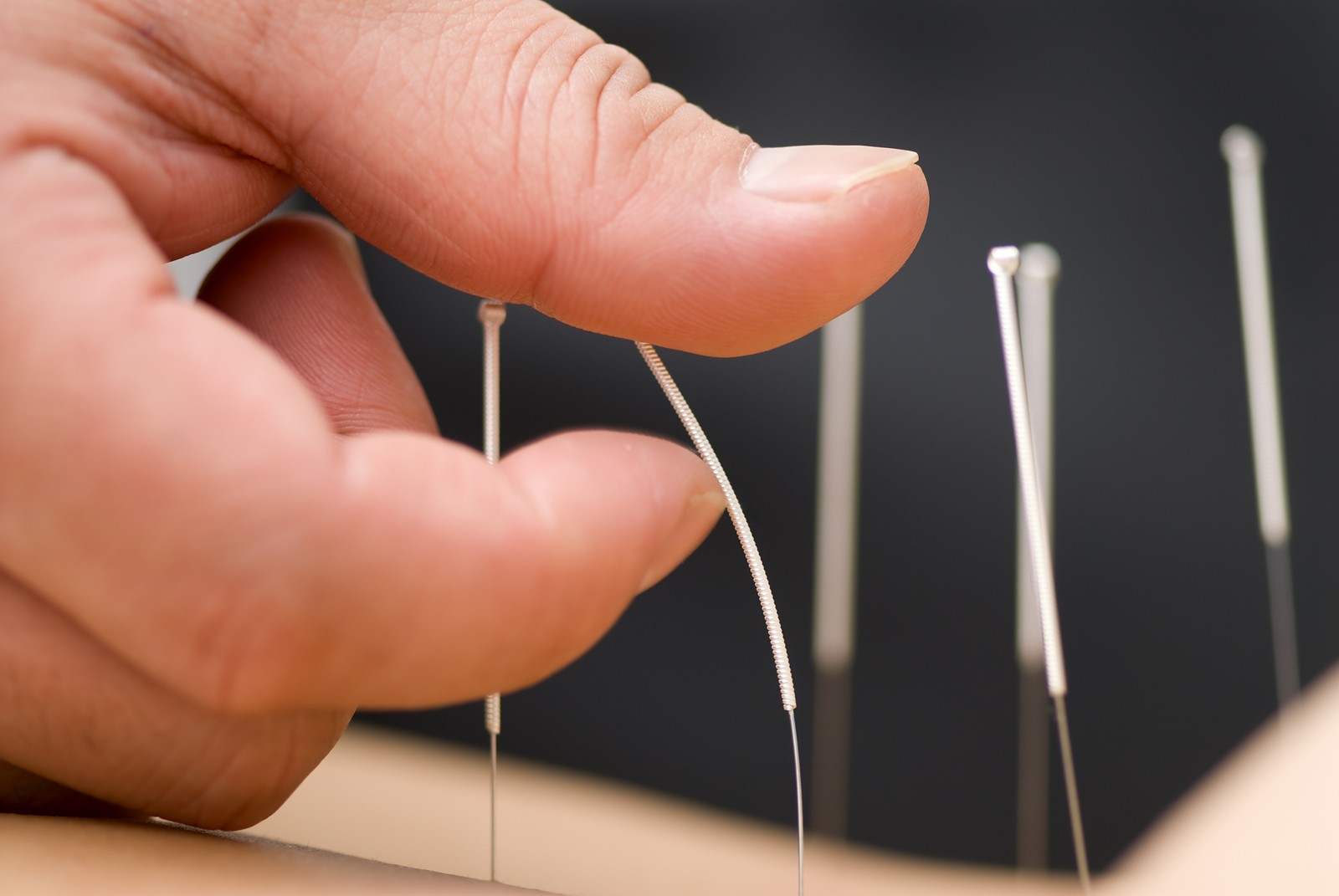
Most people who have never had acupuncture do not realize how thin acupuncture needles are. They bend when you touch them.

2. Kids do it.
Acupuncturist Adam Cantor reminds people that the needling sensation from acupuncture is so gentle that even kids are cool with it.
"If children are okay with getting acupuncture, it can't be so bad," says Cantor.
Acupuncturist Naomi Richman takes a similar approach when faced with needle-phobic adults. "I had an exclusively pediatric acupuncture practice for six years, and I still see a ton of kiddos for acupuncture," she says. "When adults tell me they are afraid of needles, I share anecdotes about a child I recently saw who was really brave, or I tell them, 'This morning, I did acupuncture on a two-month old.'"
Acupuncturist Robin Green has a whole website dedicated to kids loving acupuncture. This is a real thing.

3. Don't call them needles.
Different needles sizes compared to a dime
Sometimes just changing terminology can help assuage needle fears.
"I've found that simply changing the word 'needle' to 'pin' helps shift the mindset away from needle phobia," says acupuncturist Amy Kuretsky. "My patients love saying that I stick them with pins instead of puncture them with needles!"
Acupuncturist Jodi Knauer has another name for acupuncture needles: "I have several patients who refer to acupuncture needles as 'magical healing sticks,'" says Knauer. "This tiny shift in perception, away from the western-medical 'needle,' can help to release fears and phobias around acupuncture."

4. You're in control.
People commonly assume that they cannot move once the acupuncture needles are in place. That they need to lie there stiff as a board lest they endure excruciating pain or damage their insides. Understandably, this leads to a lot of anxiety and out-of-control feelings.
But it's not true. A good acupuncturist will go at whatever pace you're comfortable with. If you want to start with only a few needles and not keep them in very long, tell your acupuncturist that. If you want to pull out a needle that's bothering you, go for it.
"I tell my patients that we can go as slow as they want so that they feel like they are part of the experience," says acupuncturist Po-Hong Yu. "Acupuncture is not about something happening to you. You have a voice."
One thing you can ask for is that your acupuncturist avoid acupuncture points in your arms.
Acupuncturist Kerry Jenni, a self-described needle phobe who realized after becoming an acupuncturist that acupuncture needles are nothing like the ones she's scared of, says that keeping her arms free during her early days of receiving acupuncture was helpful.
"Moving during acupuncture is a weird sensation," says Jenni. "With your arms free, you can be more in control."
Acupuncturist Christina Morris makes sure that her fearful patients remain at ease once the needles are in. "I leave the patient with a pager so that they can alert me if they're feeling overwhelmed when I'm outside the room."

5. It's not all about needles.
"If the needles really freak you out, there are other modalities that acupuncturists can use," says acupuncturist Paola Acuna.
Acupuncturists are trained in several healing techniques, and only one of them uses needles. There's acupressure, cupping, gua sha, moxibustion, ear seeds, qigong, herbs, among others. None of these things involve needles.
So, what do you say? Maybe 2016 is the year you overcome your fears and try acupuncture. Here are 16 reasons to go for it. Already sold? Find an acupuncturist now.